
Products
High-Performance Specialty Fiber Webbing
Engineered Materials for the Edge of Performance
Polyester, polypropylene, and polyamide cover the vast majority of webbing applications worldwide — and the vast majority of our production. They are the fibers we recommend by default, because for most applications, they are the right answer.
There are applications where they are not.
When webbing must withstand temperatures that exceed 200°C in continuous service. When tensile strength must exceed any commodity fiber by an order of magnitude relative to weight. When cut resistance, ballistic protection, chemical immunity in aggressive environments, or dielectric performance becomes the defining engineering requirement — these applications call for engineered specialty fibers.
We work with this fiber class on a project-specific basis. We do not maintain stock inventory of specialty fiber webbing. Each project begins with the customer's performance specification, the application context, and the regulatory environment. The fiber, weave, and finishing are engineered against that specification.
This page describes the specialty fiber families we work with and how we approach this work.
How We Work With Specialty Fibers
Our specialty fiber work is structured around three principles.
Project-by-project engagement. Every specialty fiber project begins with the customer's specification — required tensile properties, environmental conditions, regulatory framework, and end-use context. We do not select a fiber on the customer's behalf based on assumed requirements. The fiber is engineered to the application.
Verified material sourcing. Specialty fibers are produced by a small number of global manufacturers, and material authenticity is consequential. We source specialty fibers exclusively from authorized distributors and verified material channels, with full lot traceability. For applications requiring specific specialty materials, we coordinate procurement with the customer's preferred or specified suppliers.
Material certification documentation. Specialty fiber webbing is generally specified within regulatory or certification frameworks — military, aerospace, industrial safety, technical performance. We maintain material certification documentation across the production cycle, supporting customer compliance verification with the end-use regulatory body.
These projects operate on extended timelines compared to commodity fiber work — typically 8 to 16 weeks from specification to delivery, depending on material availability, weave complexity, and certification requirements. Minimum order quantities are determined by material economics on a per-project basis.
Specialty Fiber Families
We work with five primary specialty fiber families. Each represents a distinct class of engineering performance, and each is selected against a specific application profile.
Para-Aramid Fibers
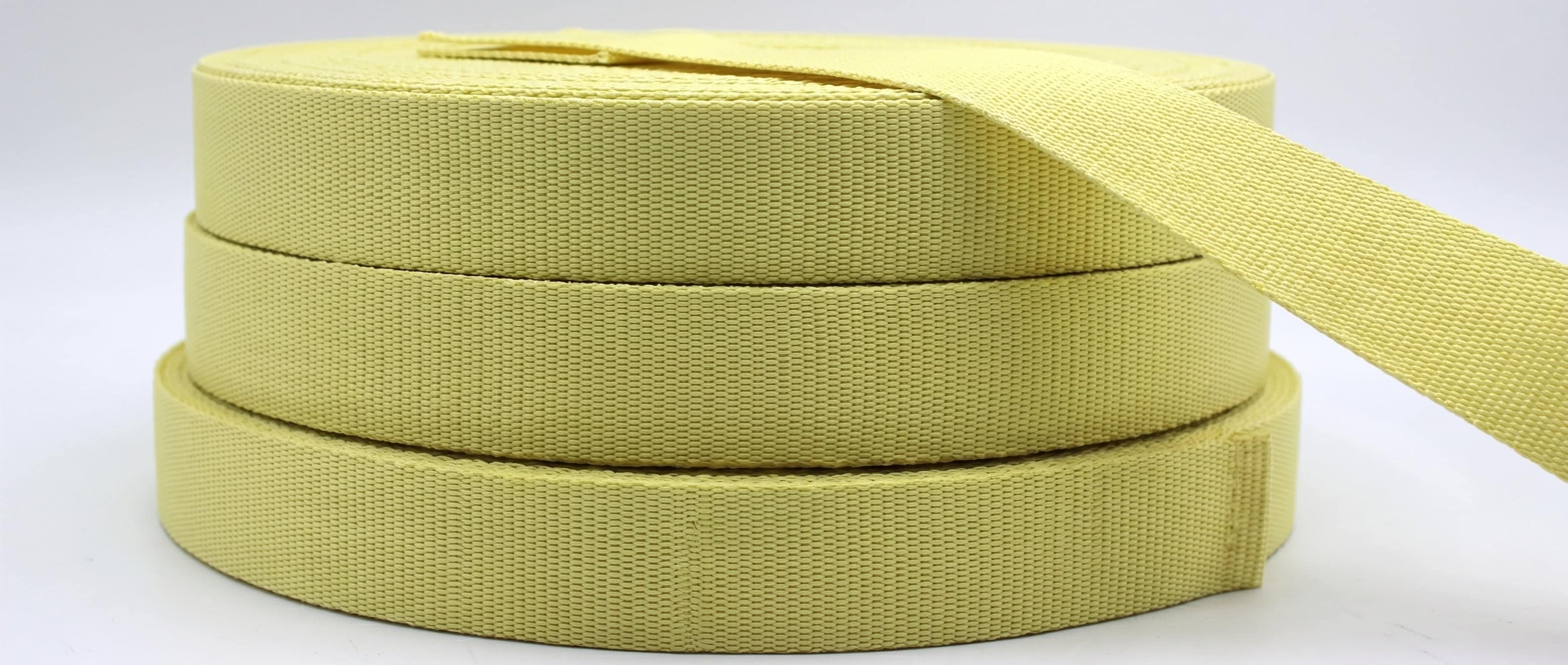
Para-aramid is a class of synthetic polymer fibers engineered for exceptional tensile strength, thermal stability, and cut resistance. The fiber is characterized by its rigid molecular structure, which delivers tensile strength approximately five times that of steel by weight, continuous service temperatures up to 200°C, and inherent flame resistance without chemical modification.
Typical applications
- Ballistic protection systems
- Cut-resistant industrial webbing
- High-temperature industrial belting
- Military and law enforcement protective equipment
- Aerospace and defense load-bearing applications
- Fire service and emergency response equipment
Engineering notes
Para-aramid is UV-sensitive and degrades under prolonged sunlight exposure unless protected. Webbing intended for outdoor use generally requires either UV-protective overwrap or jacketing. Para-aramid does not tolerate piece-dyeing well and is generally used in its native fiber color (yellow-gold for most grades).
Liquid Crystal Polymer (LCP) Fibers
Liquid crystal polymer fibers offer some of the highest specific strength and modulus available in textile materials, with exceptional dimensional stability under load and minimal creep over time. The fiber maintains performance in challenging chemical environments and offers excellent resistance to mechanical fatigue.
Typical applications
- High-load applications where dimensional stability under sustained load is critical
- Marine and offshore applications
- Advanced aerospace and defense systems
- Technical industrial applications requiring chemical and mechanical resilience
Engineering notes
LCP fibers are produced by a limited number of global manufacturers, and material lead times can extend project schedules. LCP is generally used in its native fiber color (pale yellow). Specialty surface treatments are available for specific application requirements.
Ultra-High-Molecular-Weight Polyethylene (UHMWPE) Fibers
UHMWPE is a polyethylene fiber engineered through gel-spinning to achieve molecular alignment that delivers extreme tensile strength relative to weight. The fiber offers tensile strength comparable to or exceeding para-aramid at lower density, excellent abrasion resistance, and chemical immunity across a wide range of acids, alkalis, and solvents.
Typical applications
- High-strength lifting and rigging
- Marine and offshore mooring
- Climbing and recreational technical equipment
- Ballistic protection systems
- Lightweight tactical applications where strength-to-weight ratio is decisive
Engineering notes
UHMWPE has a relatively low melting point (approximately 150°C) and exhibits creep under sustained load — characteristics that must be designed into the application. The fiber does not absorb dye and is used in its native color (white). UV resistance is good without additional treatment.
PTFE Fibers (Polytetrafluoroethylene)
PTFE fibers offer exceptional chemical resistance — effectively immune to all common acids, alkalis, and organic solvents — combined with continuous service temperatures up to 260°C and outstanding low-friction surface properties.
Typical applications
- Chemical processing industry webbing
- High-temperature industrial filtration systems
- Sealing and gasket applications
- Specialized aerospace and defense systems
- Applications requiring chemical immunity in aggressive environments
Engineering notes
PTFE is mechanically softer than most engineering fibers — tensile strength is significantly lower than para-aramid or UHMWPE. The fiber is selected when chemical and thermal performance outweigh mechanical strength requirements. Native color ranges from white to gray-brown depending on grade.
High-Performance Polymer Fibers
A category of engineered polymer fibers selected for specific combinations of thermal stability, flame resistance, and chemical resistance. Polybenzimidazole offers among the highest continuous service temperatures of any organic fiber, with inherent flame resistance and excellent thermal degradation behavior — used in firefighter protective gear, aerospace applications, and high-temperature industrial environments. Polyphenylene sulfide combines chemical resistance with elevated thermal performance — used in industrial filtration, chemical processing, and specialized protective applications.
Typical applications
- Firefighter and emergency response protective equipment
- Aerospace and defense systems requiring extreme thermal performance
- Industrial filtration in aggressive thermal-chemical environments
- Specialized military and tactical applications
Engineering notes
These fibers are engineered for specific performance envelopes. Selection between fiber families is application-driven and often requires technical consultation with the customer's engineering team. Material lead times vary by fiber and grade.
What We Do Not Promise
We are direct about the limits of our specialty fiber work.
We do not stock specialty fiber webbing.
Production begins after specification finalization and material procurement. Lead times reflect this.
We do not act as authorized distributors of branded specialty fiber materials.
When customer specifications call for specific branded specialty materials, we coordinate procurement through authorized distribution channels or through customer-specified supply arrangements. We do not represent ourselves as direct partners of any specialty fiber brand owner.
We do not certify performance to military or aerospace specifications without third-party verification.
Specialty fiber webbing intended for regulated end-use is verified through accredited testing laboratories. Performance claims are based on third-party test reports, not internal assertions.
We do not accept specialty fiber projects below minimum economic thresholds.
Specialty fiber materials carry substantial cost relative to commodity fibers, and material MOQ from suppliers determines project feasibility. We are direct with customers about minimum project sizes during initial inquiry.
These constraints reflect how the specialty fiber industry operates. We work within them honestly.
Project Inquiry Process
Specialty fiber webbing projects begin with technical discussion. We need to understand four elements before quoting:
The performance specification.
Required tensile strength, elongation behavior, thermal performance, chemical exposure profile, and any specific regulatory or certification requirements.
The application context.
End-use environment, expected service life, integration with downstream manufacturing, and any constraints imposed by customer assembly processes.
The regulatory framework.
Whether the application falls within military specifications, aerospace standards, industrial safety regulations, or other compliance environments — and what documentation is required.
The commercial parameters.
Annual volume estimate, target pricing range, and any constraints on material sourcing or supplier qualification.
With this information, we can confirm whether the project is a fit for our facility, propose appropriate fiber selection, identify material sourcing requirements, and provide an accurate timeline and price structure.
Inquiry
Specialty fiber webbing is engineered work, not catalog work. Every project starts with a technical conversation — fiber selection, application context, regulatory requirements, and project economics.
If you have a specialty fiber webbing requirement, contact Mason directly for technical discussion.